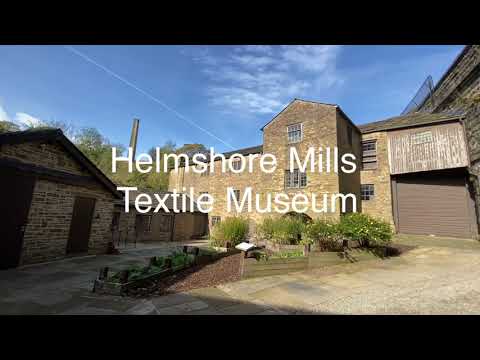
Helmshore Mills Textile Museum
Visit a place where Lancashire’s industrial past is brought to life through a multi-sensory experience like no other. Witness our spellbinding historic machinery in action; where the noisy clicks, clunks, thumps and distinctive scents will transport you to another era.
Nestled in a stunning rural location, the museum consists of two historic working mills: Higher Mill a wool-fulling mill and Whitaker Mill a cotton mill. Explore the site to learn about an industry that shaped local Lancashire lives and the industrial heritage of Britain.
There is lots to discover to feed curious minds of all ages. Don't miss our amazing working original machinery demonstrations!
Discover the magic of the mills
What's on: events and exhibitions
Search for the latest events at Helmshore Mills Textile Museum. If there are no current events listed check back for new events soon. We look forward to seeing you.
Previous events include special event days, seasonal fairs, exhibitions, walks, trails, talks, workshops, murder mysteries, and live music events.
Plan your visit
Opening times
Saturday 4 April 2026 to 1 November 2026
| Monday | Closed |
| Tuesday | Closed |
| Wednesday | Closed |
| Thursday |
11:00am to 04:00pm |
| Friday |
11:00am to 04:00pm |
| Saturday |
11:00am to 04:00pm |
| Sunday |
11:00am to 04:00pm |
Admission charges
Adults £5
Children up to the age of 18 - free
Friends - free (proof of membership required)
Xplorer pass - £25
How to find us
Helmshore Mills Textile Museum, Holcombe Road, Helmshore, Rossendale, BB4 4NP
Plan your journey and view bus timetables for your area. Why not take advantage of our bargain bus fare offers to visit?
By car
Helmshore is one mile south of Haslingden on the B6235.
By bus
X41 Manchester – Helmshore – Accrington service, come off at Gregory Fold/Helmshore Road stop.
We are closed on all Bank Holidays.
Map
Things to see and do
Two huge mills, one great space to fire the imagination and stimulate the senses.
Nestling side by side in the quiet village of Helmshore in the stunning Rossendale Valley are two original Lancashire textile mills, Higher Mill and Whitaker’s Mill, together known as Helmshore Mills Textile Museum.
Discover the people and stories behind the industrial revolution
The museum divides its collections into two themed areas, representing the wool story and the cotton story. Experience our family friendly, hands-on interactives and see textile history brought to life with the waterwheel, carding engines and spinning mules. Learn how life would have been for the workers and see the spectacular spinning floor with all the same machinery as when they walked the creaking wooden floors.
Filming projects
Helmshore Mills Textile Museum has been used as a backdrop for numerous filming projects – from documentary, factual, topical to drama productions. See where some of your TV favourites were filmed including:
The Adventures of Greyfriars Bobby
North and South
Celebrity Antiques Road Trip
Robson Green: How the North Was Built
Great British Bake Off
The English Game
Here's what some of our visitors had to say:
"A great afternoon. Full of information and touches of humour."
"Lovely, informative, very friendly staff, a great place to visit"
"Amazing museum, very engaging for a 3-yr-old, a 41 yr-old and a grandma!"
"Wonderful day – informative staff, excellent displays & good tea and cakes! Five stars."
"Fantastic! Loved every minute!"
"Fabulous tour, absolutely amazing stories – will be back!!"
"Wonderful to see so much local history retained here and to see the machinery actually working."
"An absolute gem! This is a vital museum for understanding Lancashire history. Wonderful info & incredible machines!"
Higher Mill was constructed in 1789 and Whitaker’s Mill in the 1820s by the Turner family, textile manufacturers from the Blackburn area. While Higher Mill has always been a wool fulling mill, Whitaker's Mill for the first century of its existence alternated between working wool and cotton; but by the late 1920s it was solely working recycled cotton. In 1967 Higher Mill closed and was taken over by the Higher Mills Trust who maintained it as a museum.
Although a considerable part of Whitaker's Mill was destroyed in a fire in 1857, it was rebuilt shortly afterwards and continued to be in operation until 1978. It was then acquired by the council, who by then had taken over running Higher Mill on behalf of the Trust, and the two mills were joined as one museum.
Helmshore’s railway line was constructed in 1849, but the route went right through the East corner of Higher Mill! The owner at the time, William Turner (1793 - 1852), however happily agreed to the plan as he received around £5000 in compensation (that’s equivalent to around £400,000 in today’s money!)
With this, he was able to replace the two small waterwheels powering the fulling machinery with a single bigger (and more efficient) breast shot waterwheel, which is still in use today!
On the ground floor of Higher Mill is the fully operational, large waterwheel which used to drive five pairs of fulling stocks and all the other machinery in Higher Mill.
Our current waterwheel is a big high breast shot wheel, which replaced two smaller ones, and is fed by a large mill pond. Power is generated by the weight of the water in the buckets of the wheel, which each holds about 70 gallons (300 litres), turning the wheel through gravity rather than by the flow of a watercourse. The heavier the load of water, the greater the power generated.
The wheel includes original metalwork which dates back to the late 1840s, while the wood dates back to various repair and restoration projects over the wheel's long life. The latest restoration project was in 2014, when the large central oak spokes were all replaced to ensure that the wheel will keep operating for many more decades to come.
Facilities
Car park
Cafe
Gift shop
Assistance dogs welcome
Full disabled access
Access
The museum is widely accessible with ramps and lifts, the old flag floors are however uneven as are the outdoor areas.
See the access statement (PDF KB) for more detail or please ring us if you have any questions.
Contact us
Telephone: 01706 226 459
If you've visited us recently, don't forget to leave us a TripAdvisor review.
Discover more of Lancashire's diverse history and visit one of our other Lancashire Museums. Which of our museums will you visit next?
If you've visited us, what was your favourite thing you learnt about Judges' Lodgings? Let us know by sharing your experiences on Twitter using #HelmshoreMills and don't forget to tag in @LancsMuseums on X and @LancsMuseums on Facebook.
Museum loan boxes
Our museum loan boxes contain a wide range of historical artefacts, replica objects and useful resources.
Loan boxes are a great way of bringing a little bit of the museum into your classroom.
Learn more about loan boxes.
Schools
Heritage Learning Lancashire's aim is to give pupils the opportunity to explore and appreciate Lancashire's rich heritage through access to our unique collections and stimulating sites.
Find out about school visits to Helmshore Mills.
Check for Special events weeks.
Find out more about Learning with Lancashire Museums.
Primary school teacher said:
The students love using the items we loan from you and it adds real value to the teaching of history.
Learning sessions
Pupils will be immersed in the sights, sounds and smells of mill life as they witness original machinery at work.
Discover how raw wool and cotton were transformed into yarn ready to be woven into cloth, and learn how the ideas of the famous local inventors revolutionised the world in which we live today.
Choose two core activities to make up a full day of learning.
Learning activities
What was it like to work in a mill? Examine working conditions and discover a range of jobs as you learn how cotton is turned into yarn in a cotton condenser spinning mill. Your journey will begin in the intriguingly named ‘Devil Hole’ and end with a machinery demonstration on the spinning floor.
Half day session for KS1 and KS2.
Take a guided walk beyond the mill gates to explore how the Industrial Revolution and the arrival of the mills changed the landscape. Then build an interactive 2D map to examine the impact of the Turner family on the local area. Pupils will also investigate the events of the power-loom riots of 1826 and the sad, sad tale of Mary Hindle.
Half day session for KS2.
Explore the changes in the spinning industry and life in a Victorian Mill Worker's home.
Take a journey through the Industrial Revolution, from the domestic woollen industry to the time when cotton was king. Follow the inventions that made it happen, and the lives of the people it affected.
An opportunity for your pupils to handle real objects from Victorian domestic and working life.
Half-day session for KS1 and KS2
Thank you for your interest in visiting this wonderful heritage site. We would be pleased to welcome you and share our enthusiasm for this very special place.
If you choose to visit us, your students would have guided content throughout the day. They would complete a round-robin of four activities:
Cotton Story – time on the spinning floor, including a machinery demonstration.
Revolution Gallery – a guided exploration of the machines that enabled the Industrial Revolution and a look at the lives of some of the key people.
Mill Town 1 – a guided walking tour to see the impact of the mill owner and the industrial revolution on the locality. Students engage in a short interactive drama piece about the Power Loom Riots.
NB if the weather is poor this session will be swapped for a hands-on Victorian/early 20th century handling session focussed on work and home.
Mill Town 2 – an investigation using a 3D model of the developments locally. Students map out and plan an industrial settlement.
We do not provide any additional materials such as worksheets, we prefer to have students experiencing and doing!
When can I visit? School visits are only available on a Mon, Tues or Weds.
Max. numbers approx. 80 per day
Timings
We would start at 10am (arrival from 9.50am) students would complete two of the four sessions in the morning.
Break for lunch approx. 12 noon – 12.30pm and then complete two sessions in the afternoon 12.30 – 2.30pm. Students will need to be supervised on the stairs and in the toilets which are on a different floor to the lunch space.
These general timings can be tweaked (except for the 10am start) to fit in with your travel plans.
Accompanying adults
You would need to provide enough accompanying staff to comply with your school outdoor visits policy, but also bearing in mind your total group will be subdivided and be in very different parts of the mill/village during the day.
We recommend that you provide at least two adults with the group who are on the Mill Town 1 (outdoor session.)
Costs for Lancashire County Council Schools / Lancashire Academies and Non-Lancashire County Council schools
Either £6 per student (LCC school) OR £8 per student (for a Lancashire Academy or non-LCC school)
No cost for accompanying adults
If you would like to make a booking please complete an enquiry form on this website. Please note: for large numbers we recommend booking at least four months in advance. Autumn 2 is particularly busy.
Cost
Half day (10am – 12noon) £3 Lancashire County Council (LCC) pupil; £4 Academy / Non-LCC pupil
Full day (10am – approx. 2.30pm) £6 LCC pupil; £8 Academy / Non LCC pupil
Accompanying adults free
Facilities
Lunch facilities
Coach drop off
Coach parking
Fully physically accessible
Toilets
Gift shop