
Bathing water quality
Key findings for Lancashire-14 in 2025 and 2026
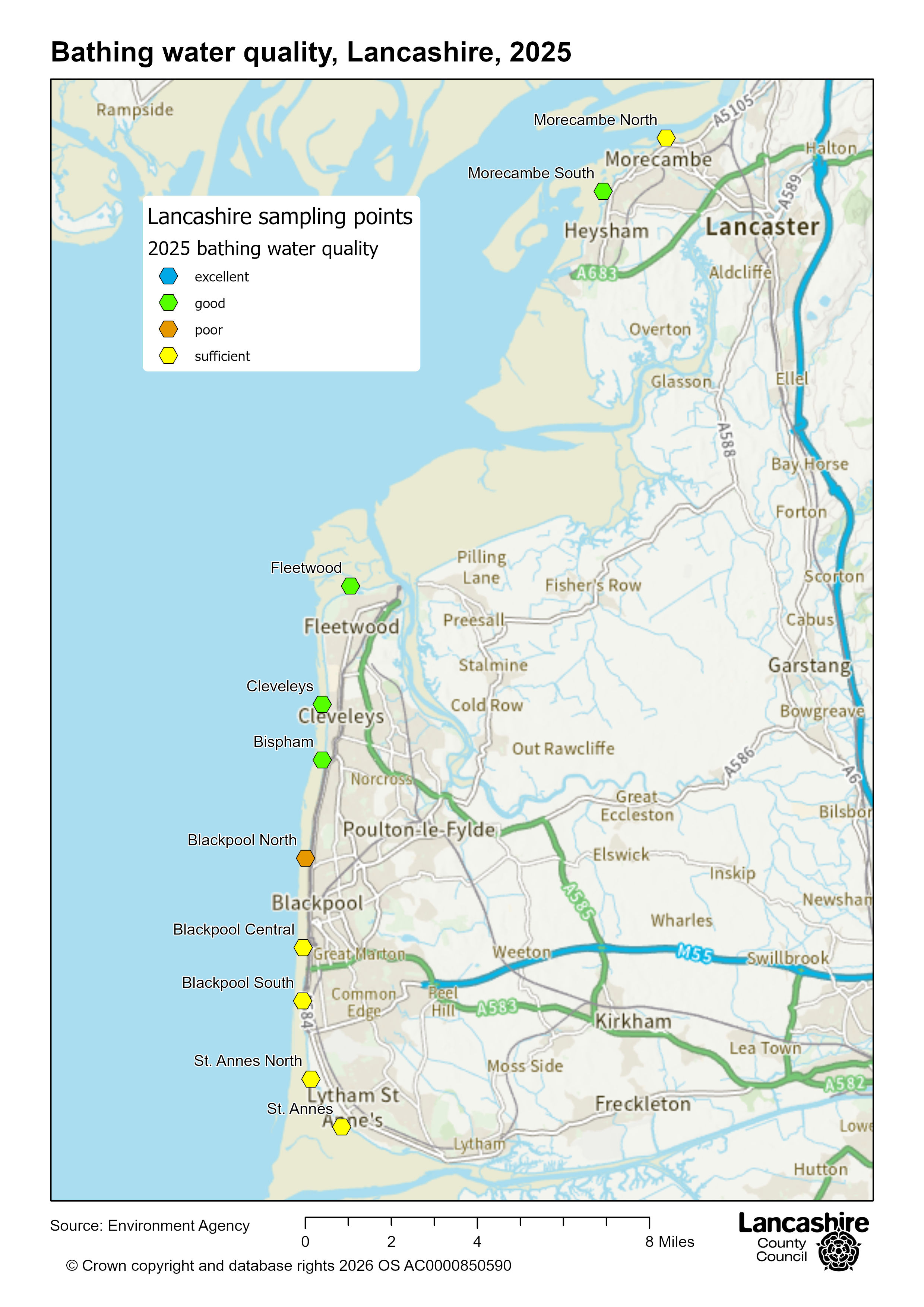
No beaches were classified as excellent in 2025.
Four out the ten beaches in Lancashire and Blackpool were classified as having good water quality in 2025.
There were five beaches in the Lancashire-14 area classified as having only sufficient water quality in 2025.
There was one beach, Blackpool North, in the Lancashire-14 area classified as having poor water quality in 2025.
There were no beaches in the North West of England to be awarded a Blue Flag in 2026.
All seven of the beaches to receive the Seaside Award in the North West were in Lancashire in 2026, but there were none in Blackpool.
The Environment Agency collects data on the cleanliness of bathing waters around the country and its website includes the bathing water data explorer. We have included a small map of the beaches in a Microsoft Power BI slide. Pointing your cursor at the dots will reveal the name and standard of the beach. If you click on the double-headed diagonal arrow near the bottom right of the slide the size of the map will be maximised to the full screen.
The latest results for 2025 that were published by the Department for the Environment, Food and Rural Affairs (DEFRA) in December 2025 were the tenth measured against standards required by the 2006/7 Bathing Water Directive. The classifications are based on a rolling average over four years, rather than just the last complete year of measurements which the previous classifications used. None of the beaches in Lancashire was classified as excellent, four were classified as good, five only reached the 'sufficient' standard, while the beach at Blackpool North remained at the 'poor' standard. Overall the results for Lancashire beaches in 2025 were disappointing when compared with 2021. Blackpool North was one of only two beaches in the North West to be classed as poor and was one of only 32 waters in the whole of England. The inland water at Edisford Bridge in Ribble Valley was also classed as poor. This was the only inland water in Lancashire to be assessed. The only change from 2024 is that St. Annes North improved from poor to sufficient.
Blue Flag is an international award scheme which acts as a guarantee to tourists that a beach or marina they are visiting is one of the best in the world. The Blue Flag compares beaches throughout the world that meet high standards of cleanliness and management, promote coastal environmental care, are patrolled by lifeguards, accessible and have attained the higher guideline standard of water quality. It refers only to the busier 'resort' beaches. The 2026 results revealed 61 beaches across the country gaining the award, with none of these being in the North West. Blackpool South had won the award for three years running from 2016 to 2018 while been the only winner in the North West region. The Royal Albert Dock and Salthouse Dock Marina at Liverpool was awarded a Blue Flag, but it doesn't count as a beach.
The Seaside Award is focused on raising standards at the coast. The award is said to reflect the great achievements of England's beach managers and helps them in future planning for beach improvements and developments. In 2026, the Seaside Awards (in conjunction with Keep Britain Tidy) the same website showed all seven winners in the North West were in Lancashire. The beaches are Morecambe North and South (Lancaster City Council), Ferry, Jubilee, Marine and Rossall (Wyre Borough Council), and St. Annes Pier (Fylde Borough Council). The usual (Blackpool Council) beaches, Bispham, Blackpool Central and South, were not awarded in 2026.
Beach in Lancashire
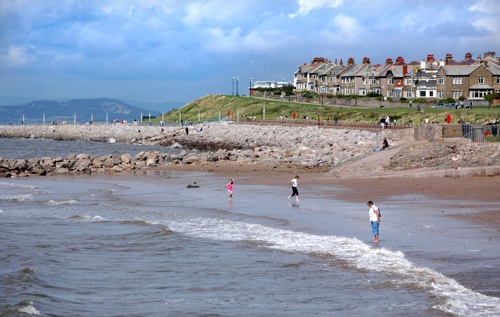
Table 1, Bathing water quality at Lancashire beaches, 2021 to 2025
| Beach | 2025 | 2024 | 2023 | 2022 | 2021 |
|---|---|---|---|---|---|
| Bispham | good | good | good | excellent | excellent |
| Blackpool Central | sufficient | sufficient | sufficient | sufficient | good |
| Blackpool North | poor | poor | poor | poor | sufficient |
| Blackpool South | sufficient | sufficient | sufficient | sufficient | good |
| Cleveleys | good | good | good | good | good |
| Fleetwood | good | good | good | good | good |
| Morecambe North | sufficient | sufficient | sufficient | sufficient | good |
| Morecambe South | good | good | sufficient | good | good |
| St Annes North | sufficient | poor | poor | sufficient | sufficient |
| St Annes Pier | sufficient | sufficient | sufficient | sufficient | good |
Further information
This article deals with the quality of water present at specified Lancashire beaches, which is most relevant to bathers entering the water there, and the quality of the beaches themselves, in terms of tidiness, littering and facilities, these being features which affect all visitors. The beaches are found in just three of the 12-districts that are within the Lancashire County Council area, namely Lancaster, Wyre and Fylde, and in one of the two unitary authorities, namely Blackpool.
Organisations which provide classifications for beaches in the UK
The article uses bathing water quality results derived from the Department for Environment, Food and Rural Affairs website that were published in November 2025.
Please also see the Environment Agency website that contains a wealth of details regarding the state of the local environment. Online maps include topics such as risk of flooding, pollution, river water quality and air pollution. There is also the Environment Agency's bathing water data explorer.
The Environment Agency state that the top five sources of pollution to bathing waters are:
· Runoff from agricultural land where manure from farmed animals gets washed into rivers and streams and then into a bathing water.
· Runoff from urban areas can carry animal and bird fæces through surface water drains to bathing waters.
· Wrongly connected sewers from homes and businesses can discharge to surface water drains putting raw sewage into the surface drainage system and potentially into bathing waters.
· Animals and birds can be a significant source of pollution at certain sites
· Sewage from sewage treatment works and storm discharges.
Keep Britain Tidy is an environmental charity that is responsible for the blue flag and seaside awards, and this article draws attention to the Lancashire results for these two initiatives.
449 bathing waters were monitored in 2025 in England, 112 in Wales, 89 in Scotland and 33 in Northern Ireland making a total of 683 across the UK. Most of these are coastal and only a few are inland waters in Great Britain
The Environment Agency samples North West beaches between May and September to assess the performance against bacteriological standards laid down in the 2006/7 EC Bathing Water Directive. This replaced the 1976 directive and only came into effect in England in March 2015. Before Brexit the directive was drafted into UK law. In 2024 there was a government consultation on reforms to the legislation. The 2025 results are therefore the tenth to be measured against the new more stringent standards. The new classifications are based on a rolling average of four years, and the weekly measurements are no longer available. In England 297 waters were classed as excellent and 32 were classed as poor.
The new standards are explained by the Environment Agency. It is possible to compare some of the thresholds with those in the 1976 directive but this is a very technical area.
The results for Lancashire beaches in 2025 are disappointing when compared with 2021. Blackpool North was one of only two beaches in the North West to be classed as poor and was one out of only 32 waters in the whole of England. The only change from 2024 is that St. Annes North improved from poor to sufficient.
United Utilities provides water and wastewater services to people living in the North West region. The company's website emphasises the popularity of the North West coast and the role of the company in improving local bathing water quality. Their website mentions investment projects in the North West that include a number of important schemes in the Lancashire area. The largest was the £160 million development in Preston which involved building a 3.5 kilometre storm water storage tunnel and the construction of shafts to divert storm water flows, which are retained in the new storage tunnel. It is supposed to reduce the number of spills to the River Ribble from combined sewers and seems to have already delivered significant improvements to the Fylde Coast bathing waters and the Ribble Estuary.
Morecambe Bay, scene photographed from Morecambe (Lancaster district)
There are other lists of national beaches that include some in Lancashire such as British Beaches and the Beach Guide. The Marine Conservation Society helps to organise beach cleaning events by volunteers.

The Blue Flag and Seaside Awards
Keep Britain Tidy is responsible for the Blue Flag and Seaside Awards (formerly known as Quality Coast Awards). Some beaches receive both awards.
Blue Flag Awards
Blue Flag is an international award scheme which acts as a guarantee to tourists that a beach or marina they are visiting is one of the best in the world. The Blue Flag compares beaches throughout the world that meet high standards of cleanliness and management, promote coastal environmental care, and have attained the higher guideline standard of water quality. It refers only to the busier 'resort' beaches. The 2025 results revealed 76 beaches across the country gaining the award, with no beaches in the North West to achieve this standard. Blackpool South was awarded the Blue Flag in 2016, 2017 and 2018. The Royal Albert Dock and Salthouse Dock Marina at Liverpool was awarded a Blue Flag but does not count as a beach.
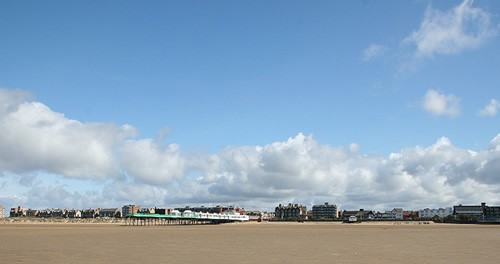
St. Annes pier
The Seaside Award
The Seaside Award is focused on raising standards at the coast. The award is said to reflect the great achievements of England's beach managers and helps them in future planning for beach improvements and developments. In 2025, the Seaside Awards (in conjunction with Keep Britain Tidy) website showed 10 winners in the North West, all of which are in Lancashire. The beaches are Morecambe North and South (Lancaster City Council), Ferry, Jubilee in Cleveleys, Marine and Rossall (Wyre Borough Council), St. Annes Pier (Fylde Borough Council) and Bispham, Blackpool Central and South (Blackpool Council). Blackpool North was not listed as a winner in 2023 or 2024.
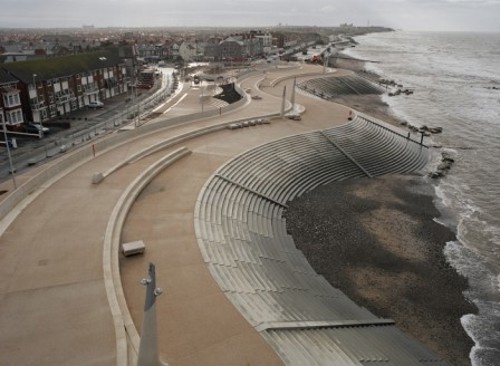
Cleveleys (Wyre borough)
Other initiatives affecting water quality at beaches in Lancashire
Catchment flood management plans
Catchment flood management plans give an overview of the flood risk across each river catchment. The Environment Agency is responsible for the management plans and GOV.UK has a link through to a number of plans for the Lancashire area.
A £20 million plan to improve sea defences at Fairhaven was approved in 2017. Lancashire has a flood risk management strategy now in place, and there are a number of projects to reduce flooding at particular risk locations. Another major project is the Wyre Natural Flood Management Project.
Surfers against Sewage Alert Service
The Sewage Alert Service is a national scheme that informs people in real time when untreated human sewage and wastewater is being discharged at a local beach. It thereby allows people to make an informed decision about how, when and where to use the sea. Under normal circumstances, there will be no alerts to mention on the site.