

Wellbeing Toolkit
Introduction
This toolkit has been developed by Lancashire County Council’s Education Services to support the wellbeing of leaders and Chairs of Governors. It brings together practical, evidence-informed resources, guidance and tools to help promote and sustain wellbeing in what can be a demanding role. The toolkit will be reviewed and updated regularly to ensure it reflects the latest resources, research and guidance available.
Lancashire County Council is committed to working in partnership with governing boards and school leaders to promote a positive culture that supports wellbeing.
While the specific legal responsibilities for health, safety and wellbeing vary depending on the type of school, all governing boards have an important strategic role in supporting and promoting the wellbeing of their headteacher. By engaging proactively with the resources in this toolkit, governors can help create the conditions in which school leaders are supported, resilient and able to thrive. Governors should also look after their own wellbeing and can use the resources in this toolkit to support their own mental health.
Contents
Section | Title |
Section 1 | Supporting Wellbeing |
Section 2 | High Pressure Events |
Section 3 | Complaints Management |
Section 4 | Personal Safety and Protecting Staff |
Section 1 — Supporting Wellbeing
Looking After Your Own Wellbeing
Leading a school is both rewarding and demanding. Leaders are required to balance the needs of pupils, families, staff, governors and external agencies whilst managing complex operational and strategic responsibilities. Over time, sustained pressure can affect both physical and psychological wellbeing.
Research in psychology and neuroscience demonstrates that chronic stress can impact memory, concentration, decision-making and emotional regulation. While short periods of pressure can help us perform and respond to challenges, prolonged stress without adequate recovery can increase the risk of burnout, anxiety and poor mental health.
Maintaining wellbeing is therefore not a luxury or a sign of weakness, it is an essential part of effective leadership. Looking after your own wellbeing helps you to make sound decisions, maintain perspective during challenging periods and model healthy behaviours for others.
There are a number of evidence-based actions that can support wellbeing, including:
• Maintaining clear boundaries between work and personal time.
• Prioritising rest, sleep and recovery.
• Building strong professional and personal support networks.
• Taking regular opportunities for reflection.
• Being physically active and maintaining healthy routines.
• Seeking support early when challenges begin to affect wellbeing.
Just as we encourage pupils and staff to seek support when they need it, school leaders should feel able to do the same. Recognising early signs of stress and taking proactive steps to protect wellbeing can help prevent difficulties from escalating and support long-term resilience.
Support is available whether you are looking to maintain your wellbeing, navigate a challenging period, access professional advice, or seek specialist support. The resources listed in this toolkit are available to help Lancashire leaders at different stages of their wellbeing journey.
Professional Reflective Supervision
Leaders regularly support others through complex situations, difficult conversations and significant organisational challenges. Professional Reflective Supervision provides a confidential, independent space to reflect on these experiences, consider their impact, and explore strategies for maintaining wellbeing and resilience.
Unlike appraisal, line management or performance conversations, supervision is non-judgemental and focused on supporting the individual in their role. Many headteachers find it particularly valuable during periods of increased pressure, such as inspections, complaints, staffing challenges or significant change.
Research and experience consistently demonstrate that regular supervision can strengthen resilience, reduce isolation and support effective decision-making. For this reason, headteachers are encouraged to access supervision proactively as part of their ongoing wellbeing arrangements, rather than waiting until difficulties arise. The section below signposts where you can access supervision.
Trauma-Informed Leadership and Difficult Conversations
School leaders regularly work with children, families and colleagues who may be experiencing adversity, trauma or significant stress. A trauma-informed approach reminds us that behaviour and responses are often shaped by experiences and circumstances that may not be immediately visible. This can help leaders to remain curious, compassionate and avoid taking challenging interactions personally.
It is also important to recognise our own responses to stress. During periods of high pressure, leaders may find themselves operating in a heightened emotional or “threat” state, which can affect decision-making, communication and relationships. Learning to recognise these signs in ourselves can help us pause, reflect and respond more effectively.
Developing skills in trauma-informed practice, emotional regulation and managing courageous conversations can strengthen both wellbeing and leadership effectiveness. Lancashire schools can access trauma-informed training and support through the virtual school (contact Vanessa.Nice@lancashire.gov.uk).
Leaders can seek guidance from their School Adviser through professional coaching, reflective supervision, or leadership support conversations. Training and support are also available to help leaders develop confidence in holding constructive, courageous conversations while maintaining positive relationships.
Chair of Governors action: Encourage professional development in trauma-informed practice and ensure the headteacher knows how to access leadership coaching, adviser support and training when required.
If You Need Immediate Support
Employee Assistance Programme (EAP)
The Employee Assistance Programme provides free and confidential counselling, advice and support for personal, family or work-related issues that may be affecting your health and wellbeing. Support is available 24 hours a day and includes counselling, legal advice, financial guidance and wellbeing resources. It is independent, confidential and available to eligible family members as well as employees.
Helpline: 0800 111 6387 and 0800 111 6385 for the managers helpline
Visit the hub: Vita Health - Login and use live chat – available Monday to Friday, 9am to 6pm. Outside these hours, call the helpline.
Go to www.my-eap.com. Enter invite code Lancsedu and click access to open the live chat.
Education Support
Education Support is the UK's charity for education staff. It offers a free confidential helpline, counselling, coaching and practical guidance for teachers and school leaders experiencing stress, anxiety, burnout or other wellbeing challenges.
Helpline: 08000 562 561
The Listening Tree
The Listening Tree provides professional reflective supervision, counselling, mediation, critical incident debriefing and wellbeing coaching specifically tailored for school leaders. It can offer valuable support during particularly demanding periods or following difficult situations.
Mental Health First Aider
Check who is a qualified mental health first aider in your school or setting. If there are none, there are opportunities for training through the Lancashire Safeguarding Partnership.
Strategic Support Partnership
Lead: Senior School Adviser - Mark Purcell
advisory.support@lancashire.gov.uk
Professional and Leadership Support
School Advisory Service (schools with a School Improvement Service Guarantee or School Improvement Service Level Agreement)
Experienced school advisers can provide coaching, mentoring and professional support to headteachers facing leadership challenges, organisational change or complex school improvement issues.
Nursery and Primary schools: contact Jane.Phythian@lancashire.gov.uk or Julie.Fryer@lancashire.gov.uk
Secondary and special schools: contact elaine.cluet@lancashire.gov.uk
SEND Senior Managers
Kirsty Ashton: Lancaster and Preston, academies, DSCO (social care link) Kirsty.Ashton@lancashire.gov.uk
Jake Kenny: Ribble Valley, Pendle, Hyndburn, Wyre and Fylde, not in setting children Jake.Kenny@lancashire.gov.uk
Catherine Martin1: Chorley, West Lancs, Burnley catherine.martin1@lancashire.gov.uk
Anthony Shaw: post 16, Rossendale, South Ribble anthony.shaw@lancashire.gov.uk
Schools HR, Legal Services and Governor Services (schools with a Service Level Agreement)
Where wellbeing is affected by staffing matters, complaints, disciplinary issues, governance concerns or legal processes, professional advice and guidance can help reduce uncertainty and support informed decision-making.
Schools HR : contact your HR contact person or SchoolsHRteam@lancashire.gov.uk
Legal Service: education.legaladvice@lancashire.gov.uk
Governor Services: contact your Area Team Leader or ECSGovernors.CentralTeam@lancashire.gov.uk
Education Partnership Officers
Education Partnership Officers can provide advice, signposting and connections to wider local authority partners, health and community services, helping schools access the right support at the right time.
Contact your local Education Partnership Officer mailbox: epo@lancashire.gov.uk
Professional Associations and Networks
Membership organisations such as NEU, NAHT and ASCL provide professional representation, legal advice, peer networks and specialist support for school leaders facing challenging situations.
Heads up 4 HTs
A national network dedicated to supporting the emotional wellbeing, resilience and professional development of headteachers and school leaders. The network provides peer support, coaching, wellbeing programmes, leadership development opportunities and informal spaces where school leaders can connect with others who understand the unique challenges of the role. Its focus is on helping leaders lead sustainably, maintain their wellbeing and avoid professional isolation.
Building and Maintaining Your Wellbeing
Wellness Action Plans
Developed by Mind, Wellness Action Plans are practical tools that help individuals identify what keeps them well at work, recognise factors that may affect their wellbeing, and agree supportive actions. They can support meaningful conversations about wellbeing and help establish proactive strategies before difficulties escalate. Wellness Action Plan
NHS Every Mind Matters
Every Mind Matters provides evidence-based advice and practical tools to help manage stress, improve sleep, boost mood and build resilience. The website includes simple self-care steps and personalised wellbeing plans. Every Mind Matters - NHS
Able Futures Mental Health Support Service
This confidential service is available at no charge to any employees with depression, anxiety, stress or other mental health issues affecting their work. Mental health support for people at work | Able Futures Mental Health Support Service
Self-Help Reading and Resources
A wide range of books, digital resources and wellbeing publications are available through libraries and trusted wellbeing organisations, providing practical strategies and insights for maintaining positive mental health.
Lancashire Emotional Health in Schools and Colleges
Schools should proactively access the offer of training and support from Lancashire Emotional Health in Schools and Colleges (LEHS) available on the website wp.lancs.ac.uk/lehsc/
Practical Support to Help You Thrive
Occupational Health
Where health concerns are affecting work, Occupational Health can provide independent clinical advice and recommendations to support wellbeing and identify appropriate workplace adjustments.
Flexible Working and Work-Life Balance
Maintaining healthy boundaries and achieving a sustainable work-life balance is an important aspect of wellbeing. Flexible working options may help individuals manage competing demands and create space for rest and recovery where operationally possible.
Support for Working Carers
Headteachers who have caring responsibilities outside of work may benefit from specialist advice, flexible working arrangements and access to local support networks. Lancashire County Council and partner organisations offer a range of resources for working carers.
The Lancashire Carers' Service - N-Compass
Care Network (Blackburn with Darwen) Ltd
MECC Link and Local Wellbeing Services
MECC (Making Every Contact Count) provides simple signposting to health and wellbeing services across Lancashire and South Cumbria, helping people access support for a wide range of physical, emotional and social wellbeing needs.
Remember
Seeking support is a sign of self-awareness and professional strength. Looking after your own wellbeing enables you to continue supporting your staff, pupils, governors and wider school community effectively. Early action, regular reflection and knowing where to access support can make a significant difference to long-term wellbeing and resilience.
Chair of Governors action:
Proactively discuss wellbeing with the headteacher and ensure they are aware of the range of support available. Encourage engagement with appropriate wellbeing and professional support networks and record relevant wellbeing discussions and agreed actions within governing board minutes; and within Headteacher Appraisal Report
Governor Responsibilities
Effective governors understand the difference between strategic oversight and operational line management. Wellbeing support from a Chair of Governors should be structured, purposeful, and separate from appraisal.
Key governor responsibilities include:
• Conducting regular, structured wellbeing check-ins with the headteacher - documented and treated with appropriate confidentiality. (the Appraisal Report provides for this at the annual and termly reviews)
• Reviewing the individual stress risk assessment with the headteacher on a regular basis if one is in place.
• Ensuring the headteacher has access to professional reflective supervision.
• Using anonymised complaints data to monitor patterns and strategic risks.
• Ensuring the school’s Health and Safety policy addresses work-related violence and aggression. (A model school work-related stress policy is also available on the health and safety website which governors may wish schools to adopt).
• Ensuring that the team wellbeing risk assessment is reviewed annually (if one is in place).
• Modelling respectful, professional behaviour - governors who are dismissive of wellbeing concerns undermine the culture they are trying to support.
Section 2 — High Pressure Events
Ofsted Inspections
Ofsted inspections can be a significant source of pressure for school leaders and staff. Whilst inspection is an established part of the accountability system, governing boards and school leaders should recognise that the anticipation, experience and aftermath of inspection may affect wellbeing, workload and stress levels.
Taking a proactive approach to wellbeing before, during and after inspection can help schools manage these pressures effectively. This includes ensuring that leaders and staff are aware of the support available, building opportunities for reflection and recovery into planning, and maintaining open conversations about wellbeing. Lancashire County Council provides a range of guidance and resources to support schools in managing work-related stress and promoting positive wellbeing – see above.
Team Wellbeing Risk Assessment
Lancashire County Council has developed a Team Wellbeing Risk Assessment for Schools, specifically designed to help schools identify and manage sources of workplace stress, including the potential impact of Ofsted inspections.
The risk assessment also incorporates content from the HSE's Talking Toolkit – preventing work-related stress in schools.
The template includes examples of common stressors that may arise in school settings, including inspection activity, organisational change, workload pressures and challenging stakeholder interactions. Schools should adapt the template to reflect their own local circumstances and specific risks.
It can be found on the health and safety website
Individual Stress Risk Assessment
This should be completed where an employee is identified as suffering from work-related stress. You will find a template on the schools portal. This is based on the Health and Safety Executive’s management standards, focusing on six key areas that the HSE believe can contribute towards stress at work. Completing the risk assessment helps to identify work-related stressors affecting an employee’s wellbeing or performance and allows actions or adjustments to reduce those risks to be agreed.
Further guidance on managing work-related stress, wellbeing risk assessments, wellbeing check-ins and support resources is available through Lancashire County Council's health and safety guidance for schools, training to support you can be found here Courses - Lancashire County Council. You can always contact your school adviser or Schools HR Team contact for support.
Critical Incidents
For support contact jane.Phythian@lancashire.gov.uk, Julie.Fryer@lancashire.gov.uk or Elaine.cluet@lancashire.gov.uk
Phone: out of hours emergency duty team; or senior adviser or school adviser
Lancashire County Council Emergency Duty Team for out-of-hours social care and safeguarding emergencies: 0300 123 6722
Phone office hours – school adviser; senior adviser, adviser admin team 01256 516166
The death of a pupil, member of staff or other significant member of the school community can have a profound impact on pupils, staff, governors and families. Such events are often emotionally demanding for headteachers, who may be required to lead and support others whilst managing their own response to the situation.
All Lancashire schools can access a high level of support that will be co-ordinated by a Senior Adviser (see above). This is the school’s first point of contact.
The support and guidance will be tailored to the exact situation that the school is facing; and will draw on a vast range of resources and other teams as appropriate.
Support for staff in school:
Employee Assistance Programme (see above)
Supervision: the school would be advised to review the current Supervision arrangements in place for all staff; and consider if this needs increasing in frequency If Supervision is not currently provided the Governing Board should review and address this need as a matter of importance.
Recovery from trauma is individual and varies in pace and style. Psychological advice is that only if someone is not recovering at a typical rate using their own support systems would a therapy such as counselling be considered. Anyone who is not recovering within a typical time you may then want to look at a stress risk assessment in work and an Occupational Health referral.
School leaders will know which staff may be more vulnerable due to previous trauma
School should look at the offer of training and support from Lancashire Emotional Health in Schools and Colleges (LEHS) available on the website wp.lancs.ac.uk/lehsc/
Chair of Governors Action
Discuss with the headteacher how the school prepares for and supports staff wellbeing (including their own) during periods of inspection activity. Seek assurance that wellbeing risks, including those associated with Ofsted inspections, are considered as part of the school's team wellbeing risk assessment and wider wellbeing arrangements. Conduct an Individual Stress Risk Assessment with the Headteacher if it is felt that one is required.
Resources and guidance for staff in supporting pupils who experience bereavement:
Winston's Wish - giving hope to grieving children (winstonswish.org)
General guidance on supporting children and young people recover from a trauma:
There is no right or wrong way for anyone to feel following a trauma
It is normal to experience – thoughts about what happened; disturbed sleep, disrupted eating patterns (loss of appetite, craving certain foods); wanting to avoid activities; highs and lows of mood (crying without real cause, finding something ordinary or even upsetting funny); being irritable
Sticking to routines in school is essential as it helps re-establish a sense of safety
For some children and young people this incident may act as a trigger for a previous trauma that resurfaces; or has not previously surfaced. Each school will need to follow its own systems to support a child/young person who expresses and displays symptoms of trauma no matter what they are related to.
Emergency / Resilience Procedures
Headteachers are reminded to keep their emergency procedures under regular review to ensure they are up to date and understood by staff. Department for Education guidance (Emergency planning and response for education, childcare, and children’s social care settings - GOV.UK) makes clear that all schools should have an emergency plan in place which explains how the setting will respond to a range of incidents, and that plans should be sufficiently flexible to cover different scenarios and reviewed to reflect current risks and arrangements.
The following resources may be helpful.
Please note that these links to the H&S website will only be accessible to schools that buy into the H&S Service Level Agreement. The emergency response plans are not on our H&S website, therefore any school with access to the portal should have access to them.
Prepare an emergency plan guidance for schools (H&S website)
Dealing with bomb threats guidance for schools and other LCC services (H&S website)
Emergency Response Plans including lockdown (Schools) documents owned by the Resilience Team (Not on H&S website)
Emergency preparedness and response general guidance for schools and other LCC services (H&S website)
Section 3 — Complaints Management
Complaints are a normal part of school life and, when handled well, can help schools resolve concerns, strengthen relationships and improve practice. Both the Department for Education and Parentkind encourage concerns to be addressed fairly, transparently and as early as possible.
However, complaints can also be one of the most challenging aspects of school leadership and may have a significant impact on headteacher wellbeing. While many concerns can be resolved through effective communication and strong relationships, some complaints are complex, persistent or highly emotive.
This section provides practical guidance for headteachers and governors on managing complaints fairly and consistently, maintaining appropriate records, and ensuring that school leaders receive appropriate support throughout the process.
Training
While training courses are not wellbeing programmes, they can help reduce uncertainty and build confidence when dealing with some of the most challenging situations school leaders and governors face, including complaints, investigations, staff conduct issues and allegations.
The following Governor Services courses may help governors strengthen their understanding of complaint handling, staff wellbeing and their role in supporting school leaders:
Minimising Complaints Through Effective Governance – explores how governing boards can contribute to a positive school culture, effective oversight and the early resolution of concerns.
Health and Safety Responsibilities for Governors – includes governors' responsibilities for staff health, safety and wellbeing, including the management of work-related stress and workplace risks.
The following training may support school leaders who are managing complex staff, parental or safeguarding issues:
Managing Misconduct – provides practical guidance on investigating and managing staff conduct matters, helping leaders approach challenging situations confidently, fairly and consistently.
Safer Recruitment and Managing Allegations – includes guidance on handling allegations against staff, understanding required processes, and ensuring appropriate support is available throughout what can often be a highly stressful situation.
There are many courses available through the LPDS website, as well as other reputable organisations.
Investigations Guide
This Investigation Guide is intended to be used in conjunction with the School Complaints Procedure at Stage 1, which requires an investigation into a formal complaint by either the Headteacher or a member of the Governing Body (if the complaint is about the actions of the Headteacher).
The advice contained in this document is designed to give assistance on the investigation process. Advice in relation to complaints and investigations can also be obtained from Legal Services and the Schools' HR Team.
Witness statements and investigation records may be disclosed as part of a Subject Access Requests. Interviewees should be advised of this and ensure that statements are factual, professional and limited to matters relevant to the investigation.
Prior to the commencement of the investigation, the following conditions should be satisfied:
I. the complainant has indicated that it is a formal complaint (raised in person, in writing or by telephone);
II. the complaint has been acknowledged in writing within the timescale outlined in the School Complaints Procedure, and clarification sought on the nature of the complaint and the preferred outcome if necessary;
A formal written response to the complaint should be provided within the timescale outlined in the School Complaints Procedure.
If timescales cannot be met, the complainant should be informed and provided with a revised response date.
Within this guide, any reference to the 'investigator' means the person responsible for conducting the investigation. In most cases this will be either the Headteacher or Chair of Governors.
The Role of the Investigator
The investigator’s role is to:
· be fair and objective in establishing the facts
· get as much information relating to the case as is reasonable
· gather information from all relevant parties
· keep the case confidential
· produce a report outlining whether or not the complaint is upheld
The investigator should:
be impartial
be of an appropriate level of seniority
have sufficient time to complete the investigation within the required timescales
Where there is not anyone within school who fulfils this, the school may decide to appoint an external investigator.
Right to be accompanied
The Complainant may ask to be accompanied during an investigation meeting by a relative or friend. The Investigator will need to consider whether the request to be accompanied is made due to a disability, as a reasonable adjustment under the Equality Act. If a school employee is interviewed as part of the investigation, they may request the support of their trade union representative. Requests for accompaniment would not be unreasonably refused. However, there is no right to legal representation under the procedure.
Procedural time limits
Wherever possible, the investigation process should be completed as quickly as possible, but it always needs to be thorough and fair. Some investigations might take longer depending on the case and how many people need to give information. For example, a simple case might only take a day to gather enough information, whereas a more complicated case could take several weeks. Any delays should be explained to anyone involved and explained in the investigation report.
The investigation process
Preparation and planning
The Investigator should begin by drawing up a proposed investigation plan, which may include:
the scope of the investigation
details of those that need to be spoken to and in what order (normally this would be complainant first, then respondent and then witnesses)
any sources of evidence, for example school records, emails etc
time frames and time limits e.g. school holiday periods
relevant policies
ensuring that all parties know the importance of confidentiality
Interviews
Interviews need to be handled in a professional and sensitive way. They should take place in a suitable venue, where confidentiality can be ensured. The situation may be highly charged, and it is important that investigators are objective and fair. The following will assist in this:
· Plan who will be the note-taker. Notes taken may become an interviewee's witness statement which they will subsequently be asked to sign. It should record the date, time and venue for the interview, the names of those present, an accurate record of the interview – questions and answers, details of any adjournments
· Plan the initial questions (see Appendix 1 for advice on interview questions)
· Write to the employee inviting them to the meeting and ensure they have copies of the complaint and the policy
· Open the meeting by explaining who is present and why, the role of the investigator, the purpose of the meeting, the need for confidentiality, that the interviewee’s witness statement will be part of the investigation report, and who will see the interviewee’s witness statement
· During the meeting an investigator should ask specific questions to gather the facts of the matter (dates, times, details); probe the interviewee but not in an adversarial manner; explore any differing versions of events; check if there are any witnesses that should be interviewed; record responses/any refusal to respond; seek evidence that may corroborate the information provided; and ensure they fully understand the complainant's preferred outcome.
· At the end of the meeting an investigator should explain that they may need to be interviewed again and explain that the interviewee will be provided with a copy of their witness statement for them to sign, confirming that it is accurate.
· After the meeting an investigator should provide the interviewee with a copy of their statement, seeking agreement that it is accurate, consider what the important facts from the meeting were and whether evidence already collected supports or contradicts these, and consider any further evidence that needs to be collected or interviews arranged.
Writing the report
An investigation report should cover all the facts that were established, and whether there were any mitigating circumstances that also require consideration.
There are usually two issues that the investigator is likely to face when concluding any investigation and writing the report:
Recognising when you have sufficient evidence/information; and
Drawing conclusions on the balance of probabilities i.e. deciding whether on balance, one version of events could be justifiably preferred to the other and why. An investigator only needs to decide that on the balance of probabilities an incident is more likely to have occurred than not.
Obviously, evidence from witnesses to the actual incident(s) and or admissions will be of most assistance in reaching a decision.
Determining a conclusion
Once the investigator has determined their view, they need to decide what their decision will be. Their first responsibility is to decide if the complaint is upheld, in full or in part or not at all and if the complaint is upheld, what action could be recommended. In recommending any outcome, the investigator should take into account the views/wishes of the complainant and the seriousness of the incident. The complainant may simply wish to ensure there is no repeat of the incident(s), whereas the investigator may determine that the matter may be too serious to leave with that outcome.
Format of report
The report should be simple and factual, and should include the following:
Background - Brief paragraph(s) to set the scene in terms of individuals involved and the date of receipt of complaint.
Nature of Complaint - Outline details of the complaint(s) with reference to the evidence from the complainant, giving dates, times and specific incidents where possible.
Investigation process - Describe the actions taken and process used to investigate the complaint.
Respondent’s Response - Give details of the respondent’s response/explanation for each of the incident(s).
Supplementary Evidence - Brief details of any witness statements or corroborative evidence (if available).
Findings and Evaluation - Details of whether the complaint can be supported or not – with reasons.
Final Recommendations - The recommendation(s) on any further action should be clearly stated.
Appendices – these may include notes of interviews, witness statements, other documentation that relates to the complaint.
Reporting the findings and follow-up actions
The investigator should provide a written report setting out their findings and any recommendations. Where the investigator is the Headteacher or Chair of Governors, they should communicate the outcome to the complainant in writing and advise them of any further stage of the procedure. Where an independent or external investigator is used, they should submit their report to the Headteacher or Chair of Governors who commissioned the investigation. The Headteacher or Chair of Governors will consider the findings and communicate the school's decision and any next steps to the complainant.
At Stage 2, the Investigator may be required to give evidence at a meeting of the Governing Body Complaints Committee.
The investigator should also consider whether there are any lessons to be learned by the Headteacher/Governing Body and if so, these should be communicated in the appropriate forum.
Potential Issues
Requests to record the meeting - Usually a notetaker is sufficient and using an audio device is not recommended. Any request to record the meeting should be considered by the Investigator and a decision made depending on the reason for the request. For example, it may be a requested reasonable adjustment due to a disability. It is important to be consistent across the investigation. All those present must give consent to be recorded. Covert recordings are not allowed.
Reluctant witnesses – The Investigator should seek to explore and resolve concerns and provide reassurance. Only in exceptional circumstances where a witness is crucial to establishing facts and has a genuine fear of reprisal should an investigator agree to an anonymised witness statement. Anonymous statements will have more limited weighting as the evidence cannot be challenged or corroborated. If the matter becomes subject to legal proceedings, and it is necessary in the interests of fairness, an employer may be required to disclose the names of any anonymous witnesses.
Disputes regarding the Witness Statements – Minor amendments can be made and then forwarded for signature. Where substantial requests are made which the Investigator is not in agreement with, the interviewee should be invited to submit their own signed statement, to sit alongside that produced by the Investigator.
Refusal to attend a meeting - The Investigator should try to find out why and resolve any issues. If it relates to availability, attempts should be made to rearrange to an alternative date. If it relates to another reason (such as illness) then the complainant may be asked to produce a written statement. If the complainant continues to refuse to attend the meeting, they should be told that the Investigator will form their conclusions based on the information they have available.
Physical evidence (eg CCTV or computer/phone records) – If physical evidence is collected then the Investigator should consider whether there are less intrusive ways of gathering the evidence, but where there are not, they should record what it is, how it was collected and what it reveals. It is legitimate to use CCTV for investigatory purposes, unless the school has a CCTV Policy which explicitly prevents this.
Significant numbers of witnesses - where the investigator is asked to speak to a large number of witnesses, they should judge the reasonableness of the request. The investigation needs to be reasonable, but also completed in a timely manner. If many people witnessed the same incident, the investigator should speak to some of witnesses and check whether they are broadly saying the same thing. The investigator does not necessarily have to talk to all witnesses.
Interview Questions
Questions to ask
Open questions - encourage an interviewee to open up. E.g:
Describe exactly what happened…
How did you react?
Has this or a similar incident(s) occurred previously?
What outcomes are you seeking in this matter?
What do you think it will take to achieve this?
Closed / specific questions usually give a Yes, No or definite answer and can be helpful to gather specific facts and/or focus an overly talkative interviewee. E.g:
· When and where did this happen?
· What were the exact words used?
· How many times did that happen?
· Did you speak to anyone else about that?
· Who else was there?
Probing questions test the strength of an interviewee’s account and challenge any inconsistencies. However, it is important to phrase these questions to be inquisitive rather than interrogative. E.g:
· When you say they were aggressive what exactly do you mean by aggressive?
· You mentioned earlier that X… tell me more about that.
Feelings questions help to focus on what is important to the interviewee and reveal their beliefs. However, they should be used sparingly as the investigation is mainly to establish facts. E.g.:
· What was important to you about that?
· What is your main concern about what happened?
Asking “What else?” helps an investigator to probe deeper beyond the initial information provided. However, care needs to be taken to ask this sensitively. E.g.:
· What else can you tell me about what happened?
· What else do I need to know about the matter?
Summarising questions provide an opportunity to check that the correct information is recorded and allow the interviewee to reflect on what they have said.
Questions to avoid
Interrogative questions - the aim of the investigation is to establish the facts rather than interrogate. Although sometimes necessary, “Why” questions can make people defensive. E.g.:
· Instead of “Why did you do that?”, use “What made you decide to do that?”
Leading questions - These can lead the interviewee to provide the answer the investigator hopes or expects to hear. E.g.:
· Instead of “Do you think he was perhaps over reacting?”, use “What did you think of his reaction?”
Multiple questions - Lead to confusion and the interviewee will answer what they heard first, last or the part they are most comfortable answering. E.g.:
· Instead of “What is your role, do you like it and why?”, ask each question individually
When Does the Chair of Governors Become Involved?
Always refer to school's own complaints policy. The below is based on the DfE model policy.
Stage / Circumstance | COG Role |
Stage 2 | Complainant is not satisfied with the headteacher’s Stage 1 response, they can escalate the complaint to Stage 2 – a meeting with members of the governing body’s complaints committee, which will be formed of the first three, impartial, governors available. |
Headteacher is the subject | If the complaint is about the headteacher, or a member of the governing body (including the Chair or Vice-Chair), a suitably skilled governor will be appointed to complete all the actions at Stage 1. |
Safeguarding link | If a complaint raises a safeguarding concern, the COG must consult with the Designated Safeguarding Lead and, if appropriate, the Local Authority Designated Officer (LADO) before proceeding. |
Complaints Log
A robust complaints log is both a statutory requirement and a practical tool for school leadership. DfE Best Practice Advice (2020) requires maintained schools and academies to keep written records of all formal complaints, actions taken, and outcomes.
A complaints log provides a clear record of concerns raised, actions taken and outcomes reached. It helps schools identify recurring themes, evidence that complaints have been handled appropriately, and demonstrate a fair and consistent approach if concerns are escalated.
It also supports headteacher wellbeing and effective governance by providing an objective record of events and enabling governors to monitor trends and risks through anonymised reporting.
What to Record
Field | Guidance |
Date received | The date the complaint was first received by the school in any format. |
Complainant name | Full name. Leave blank only for genuinely anonymous complaints (note: anonymous complaints cannot proceed through the formal procedure). |
Summary of complaint | Two to three sentences describing the nature of the concern. Factual, neutral language only. |
Actions taken | Key steps: meetings held, correspondence sent, evidence reviewed. |
Outcome | Upheld / Partially Upheld / Not Upheld. Note any follow-up actions. |
Date closed | When the school formally concluded its involvement. |
Escalation / referral | Whether the complainant referred the matter to the DfE, Secretary of State, Ofsted, or solicitors. |
GDPR | Who is responsible for these records. |
• Keep the log secure. Access should be restricted to the headteacher and designated senior staff only.
• Provide governors with an anonymised summary — not the full log — at least termly. This supports strategic oversight without breaching confidentiality.
• Review the log before any Ofsted inspection. Inspectors may ask how you monitor and learn from complaints.
• Align SAR and complaints logs. Complaints frequently trigger Subject Access Requests (see Section 14). Cross-referencing the two logs will save time and reduce the risk of disclosure errors.
• Retention: governing bodies must decide for themselves how long they keep records, unless statutory regulations apply. For example, copies of attendance registers must be retained for 3 years.
Vexatious Complaints
A vexatious complaint is one that is manifestly unreasonable, designed to cause distress or disruption, or pursued for an improper purpose. Recognising and managing vexatious complaints appropriately protects headteacher wellbeing and preserves the integrity of the school’s complaints process.
Indicator | Example |
Persistent repetition of issues that have already been fully investigated and responded to | The complainant continues to raise the same points despite thorough responses at each stage. |
Demands for outcomes that are impossible, unreasonable or outside the school’s authority | For example, demanding the dismissal of a teacher as a complaint resolution. |
Conduct of harassment: multiple contact attempts per day, abusive language, threatening behaviour | Particularly where Oracle incident records document a pattern (see Section 4). |
Seeking to involve multiple external agencies simultaneously without foundation | Referrals to Ofsted, police, media and solicitors made simultaneously without legitimate new grounds. |
Complaints clearly motivated by personal grievance rather than genuine concern for a child’s welfare | For example, complaints that coincide with child custody disputes or disputes about fees. |
Process for Designating a Complaint as Vexatious
• Document the full history. Compile a complete record of all contact and correspondence, cross-referencing the complaints log and any Oracle incident records.
• Seek advice from the school's legal services. It is worth noting the Department for Education expect a complaint to travel through the school's complaints procedure before it is labelled as vexatious.
• Write to the complainant (your legal services might do this on your behalf and become a single point of contact). Explain clearly why the school considers further contact on this matter to be vexatious. Include: the grounds for the decision, what future contact will be accepted (e.g., communications regarding the child’s education only), and the complainant’s right to refer to the ICO if they believe data rights have been breached, or to the Secretary of State for unresolved complaints.
• Define acceptable contact. Specify the one named contact point for future communications and the format(s) in which contact will be accepted.
• Leaders may wish to establish a dedicated complaints email address or mailbox, separate from the headteacher’s personal inbox. This can minimise the impact of high-volume or challenging communications on individual staff members.
The school’s complaints policy should include a section on managing serial and unreasonable complaints. If it does not, this should be addressed at the next policy review. The DfE model policy can be found here.
Subject Access Requests?
Subject Access Requests (SARs) are a right under Article 15 of the UK GDPR and the Data Protection Act 2018. In schools, SARs frequently occur in the context of complaints, disputes, exclusions and safeguarding concerns.
A SAR is a request from an individual for a copy of the personal data that the school holds about them. There are no formal requirements for the request to be valid: it does not need to be in writing, use specific language, or be addressed to a named person. If someone asks, “What information do you hold about me?” — that is a SAR.
Common SAR contexts in schools include:
• Parents requesting information about their child held in school records.
• Parents requesting information about themselves (e.g., from complaint correspondence).
• Headteachers and staff requesting their own HR and personnel records.
• Governors requesting information held about them.
• Legal representatives acting on behalf of a data subject (proof of authority required).
⚠️ A high proportion of SARs in schools are received during or immediately after a formal complaint. Cross-reference your SAR log with your complaints log at all times
Obligation | Detail |
Respond without undue delay | You must respond within one calendar month of receipt. The clock starts from the day after you receive the request. |
Respond in full | You must provide all personal data you hold about the individual, subject to any applicable exemptions. |
Free of charge (in most cases) | The default position under UK GDPR is that SARs must be handled free of charge. There are narrow exceptions — see Section 14.4. |
Respond in accessible format | If the request was made electronically, respond electronically unless the person requests otherwise. Use plain language. |
Act even during school holidays | There is no provision in the UK GDPR for extending the deadline because the school is closed. You must plan for SAR receipt during holiday periods. |
Exemptions
Schools may apply exemptions to withhold certain information from a SAR response. Exemptions must be applied carefully and documented. Common exemptions include:
• Third-party data: Information that would identify another individual (e.g., another pupil, a complainant) may be withheld if that person has not consented to disclosure and it is not reasonable to disclose.
• Serious harm test: Education information may be withheld if disclosure would be likely to cause serious harm to the physical or mental health of any person (Education Information Exemption, DPA 2018 Schedule 3, paragraph 19).
• Legal professional privilege: Legal advice sought in connection with the SAR itself is exempt from disclosure.
• Management information: Information held in connection with management of the school may be temporarily withheld if disclosure would prejudice the carrying out of management functions (though this is time-limited).
• Confidential references: References provided in confidence (e.g., staff references) are exempt from disclosure.
The Data (Use and Access) Act 2025 (in force from 19 June 2025) clarifies that schools are only required to conduct searches that are “reasonable and proportionate”. Schools do not need to provide information that the requester already holds or has direct access to, including emails sent to or from the requester. This provision is backdated to January 2024.
Charging a Fee: The Legal Position
Under UK GDPR (Article 12(5) and Article 15), the default position is clear: you cannot charge a fee to respond to a SAR. This is the starting point, and schools must apply it unless they can demonstrate that an exception applies.
There are two exceptions under which a school may charge a “reasonable fee”:
Exception | Example / Explanation |
The request is manifestly unfounded or manifestly excessive — in particular because of its repetitive character. | Example: The same request has been made and fully answered within the previous three months with no new grounds. Or the request is clearly made with the sole intent of causing disruption rather than exercising a genuine right. |
The individual requests further copies of data already provided. | If the school has already responded in full to a SAR and the individual simply wants another copy of the same information, a fee may be charged for the administrative cost of providing it again. |
Schools should seek advice from their legal services provider before applying these exceptions to ensure they apply!
What Counts as a “Reasonable Fee”?
Where a fee is lawfully chargeable, it must reflect actual administrative costs only. It cannot be used to recover general overhead or generate income. Recoverable costs include:
• Staff time spent searching for, retrieving, reviewing and redacting information. Use a realistic internal hourly rate and document the calculation.
• Printing and photocopying costs if a paper copy is requested (not if provided electronically).
• Secure delivery costs (e.g., recorded post or secure file transfer service) where applicable.
The ICO guidance (December 2025) states that costs should be proportionate, individually justified, and supported by clear criteria that the school makes available on request (though they do not need to be published online). You must inform the requester of the fee, provide a breakdown, and wait for payment before resuming work. The one-month response clock is paused from the day you request the fee until the day it is received.
⚠️ Charging must be the exception, not the default. Applying a fee routinely, or on the basis that a SAR is inconvenient or burdensome, is unlawful. If you charge incorrectly, the individual may complain to the ICO. Fines for non-compliance can reach £17.5 million or 4% of global annual turnover — and reputational damage is significant.
Extending the Deadline
The one-month deadline may be extended by a further two months where the request is complex or you have received a number of requests from the same individual. If you extend, you must:
• Inform the requester within the initial one-month period.
• Explain the reasons for the extension.
• Document the decision.
You may also pause the clock (stop the clock) if:
• You need to verify the requester’s identity — ask for the minimum necessary evidence.
• The request is unclear and you need clarification — only seek clarification where genuinely necessary; this cannot be used as a delaying tactic.
• You are waiting for payment of a lawfully-charged fee.
SARs and Complaints
When a SAR arrives in the context of a complaint, two parallel processes are running simultaneously. Managing them separately but in coordination is essential.
Practice | Rationale |
Keep a separate SAR log | Maintain a dedicated SAR log alongside the complaints log. Record: receipt date, requester identity, scope of request, any clarifications, deadline, exemptions applied, and response sent. |
Apply exemptions carefully to complaint files | Complaint files typically contain third-party information (e.g., witness accounts, other staff). Redact carefully and document every decision to withhold. |
Do not treat a SAR as a complaint | A SAR is an information rights request, not a complaint. Acknowledge and process it separately under the data protection framework. |
Seek DPO advice | Your Data Protection Officer (DPO) should be consulted on any SAR |
Do not destroy records | Upon receipt of a SAR, you must not delete, amend or destroy any relevant records. Doing so could constitute a criminal offence. |
Section 4 — Personal Safety and Protecting Staff
Where concerns arise about safety on or around the school site, schools should consider working with the police and local Community Safety Partnerships and police to address risks such as anti-social behaviour, intimidation or threats to staff (contact your Education Partnership Officer if you are unsure who to contact).
Schools should also ensure that key safety policies are in place, understood and followed. These include lone working arrangements, violence and aggression procedures, incident reporting processes and safeguarding policies. These policies are designed to protect staff and should be reviewed regularly and applied consistently, particularly where there are known safety concerns.
Personal Safety E-Learning
Lancashire County Council provides a personal safety e-learning module for all school staff, including headteachers. Completion of this module is strongly recommended for all staff who interact with members of the public including reception staff, office staff and senior leaders. 3 yearly refreshers are recommended.
Click here to access personal safety e-learning
The module should be completed on induction and revisited annually, or following any significant incident involving aggressive or threatening behaviour.
⚠️ Chair of Governors action: Confirm with the headteacher that personal safety training is included in the school’s induction process and that completion rates are monitored as part of health and safety oversight.
Prevention of Harassment
Under the Equality Act 2010, employers must take reasonable steps to prevent harassment related to a protected characteristic, including sex, race, disability, religion or belief, age, sexual orientation, gender reassignment, pregnancy and maternity.
In October 2024, a further proactive duty on employers to take reasonable steps to prevent sexual harassment of workers came into place. This duty extends to sexual harassment of workers perpetrated by third parties, such as parents, pupils, contractors or members of the public. In response to the legislation, employers are expected to assess risks, implement preventative measures and take action before incidents occur, including having effective policies, training and reporting mechanisms in place, and taking prompt action in response to complaints from employees.
The Employment Rights Act 2025 is expected to strengthen the existing protections from 30 October 2026 by requiring employers to take “all reasonable steps” to prevent sexual harassment and by introducing a specific obligation not to permit third-party harassment of employees.
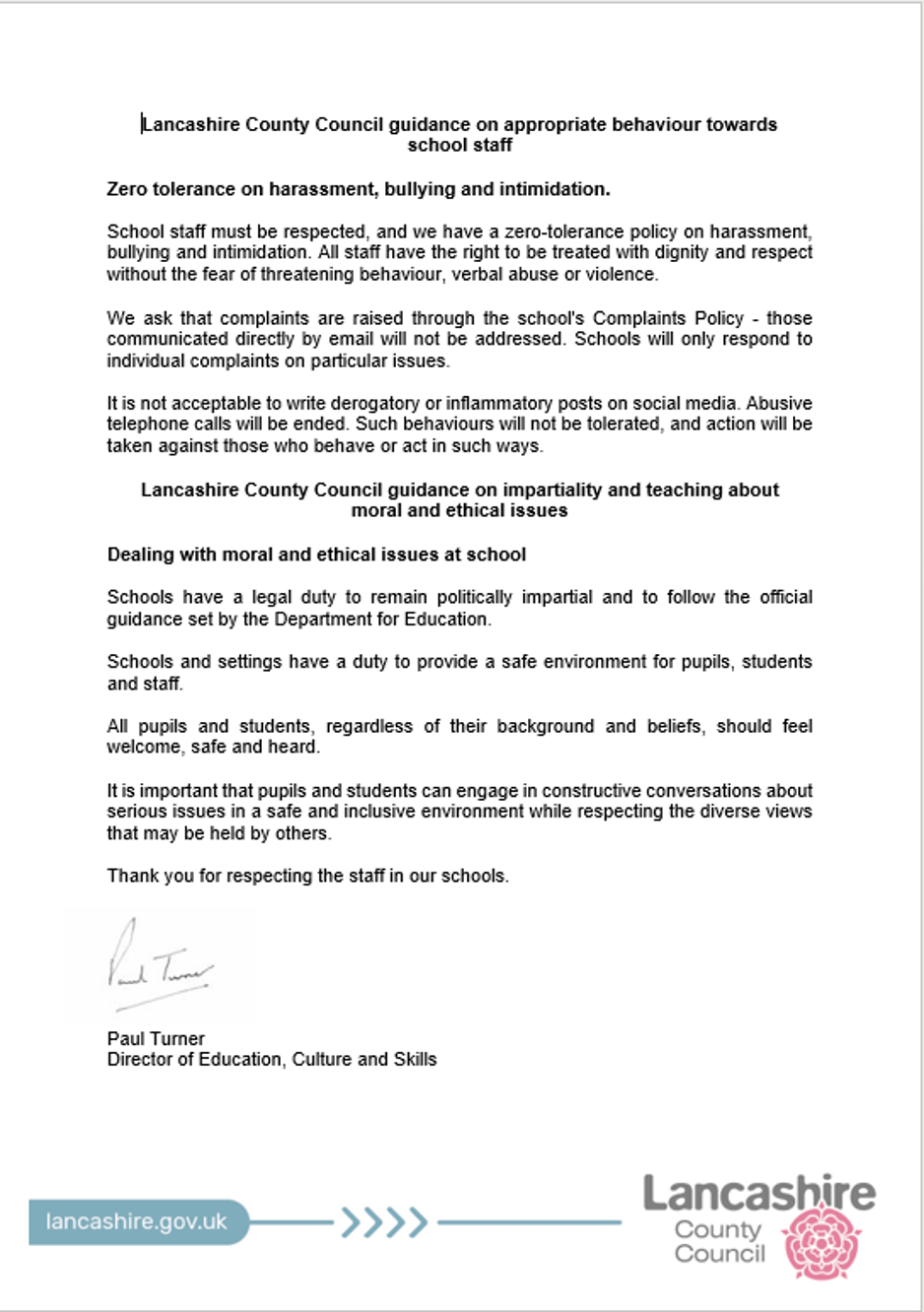
Template letter from the Director regarding Unacceptable Behaviour
Lancashire County Council has prepared a formal letter, signed by Paul Turner, Director of Education, Culture and Skills, setting out the council’s position on unacceptable behaviour directed at school staff.
The letter is intended for display in school reception areas and public-facing spaces. It communicates clearly to all visitors and community members that threatening, abusive or disrespectful behaviour will not be tolerated, and that the school has the full support of the Local Authority in enforcing this position.
Health and Safety Aspects of Wellbeing in Schools
The Health and Safety at Work Act 1974 and associated legislation places a legal responsibility on all employers to ensure that their employees and anyone affected by their work are healthy and safe. This includes considering the risk of violence and aggression in the workplace and having arrangements in place to protect employees.
The county council does not tolerate any form of violence or aggression towards its staff this includes any form of harassment directed towards headteachers and other school employees.
The Health and Safety Team offers a service level agreement (SLA) to all Lancashire schools and academies. For schools that buy into this , more detailed guidance is available on the health and safety website. Schools that do not buy into the health and safety service level agreement are advised to contact their own health and safety provider for advice and guidance.
Model School Work-related Stress Policy
Schools are strongly recommended to have a work-related stress policy, that sets out the school’s commitment to preventing and managing work-related stress, supporting employee’s wellbeing and promoting a healthy and productive working environment. You will find a model policy on the schools portal that you can adapt to meet your needs.
Training
The county council has developed eLearning modules which includes assessing the risks associated with violence and aggression in work, how to minimise the risks to personal safety and reporting procedures.
Headteachers and other staff in schools who may be at risk of act or threats of violence, aggression or harassment are advised to complete the personal safety eLearning
eLearning is also available on 'managing stress in your team' and 'identifying and managing your personal stress' which could be caused by acts or threats of violence, aggression or harassment in the workplace. (See stress section below)
Click here to access all eLearning available on Astute
Reporting
All accidents, incidents and near misses including violence and aggression or harassment from parents and carers, must be reported and investigated to identify the cause. Where necessary enhanced control measures and measures to prevent a recurrence should be put in place. Reporting is also essential in case of any future litigation or claim.
The county council's approved method of reporting is via Oracle Fusion. Further guidance on accident, incident and near miss reporting is available on the health and safety website
Work-related stress
Where headteachers and others are subject to acts or threats of violence and aggression or harassment from parents and carers, it is important to consider the impact on their physical and mental wellbeing. The individual stress risk assessment process follows the HSE management standards and allows the employee, in consultation with their manager, the opportunity to consider all aspects of their work and personal lives to determine all sources of stress. Further guidance including stress risk assessment templates are available on the health and safety website.
Dealing with Aggressive or Abusive Phone Calls
The schools portal provides information and advice on dealing with aggressive or abusive phone calls: on challenging phone calls
Action | Guidance |
Warn first | If a caller becomes aggressive or abusive, calmly state: “I need to advise you that if this language continues, I will have to end the call.” |
End the call | If the behaviour continues, state: “I am ending this call now. Please contact us again when you are ready to speak calmly.” Then end the call. You are not obliged to tolerate abuse. |
Reporting | As soon as the call ends, make a written note of the time, what was said, and any identifying information. Log the incident - The county council's approved method of reporting is via Oracle Fusion. Further guidance on accident, incident and near miss reporting is available on the health and safety website |
Do not return aggression | Responding with frustration or sarcasm escalates the situation. Remain neutral in tone throughout. |
Two-person support | For known high-risk callers, consider having a second member of staff present or listening when calls are expected. |
Call blocking | The school has the right to block phone numbers that are being used to harass staff. Document the decision and notify the caller in writing before blocking. |
Managing Aggressive Behaviour on School Premises
The schools portal provides information and advice on dealing with aggressive behaviour on school premises: violence or aggression at work.
• All staff should know and follow the school’s Behaviour on Premises policy.
• Do not attempt to physically restrain an aggressive individual unless trained to do so and it is necessary to prevent injury.
• Use de-escalation techniques: maintain calm body language, avoid direct confrontation, give the individual space, use low, steady tone of voice.
• Signal for assistance. Ensure all staff know the agreed signal or code for requesting urgent support.
• If there is an immediate risk to safety, call 999. Do not hesitate.
• Where headteachers and others are subject to acts or threats of violence and aggression or harassment from parents and carers, it is important to consider the impact on their physical and mental wellbeing. The individual stress risk assessment process follows the HSE management standards and allows the employee in consultation with their manager the opportunity to consider all aspects of their work and personal lives to determine all sources of stress. Further guidance including stress risk assessment templates are available on the health and safety website.
Recording Bullying and Harassment Incidents
All incidents of bullying, harassment, or violence directed at school staff including the headteacher must be formally recorded using the *Oracle HR system. All incidents must be investigated to determine the cause and identify whether any control measures can be applied to reduce the risk of a recurrence. Reporting is also a statutory requirement under the Reporting of Injuries, Diseases and Dangerous Occurrences Regulations 2013 (RIDDOR) for certain categories of incident, where these result in physical harm or an absence form work of over 10 days.
When to Record
Type of Incident | Action Required |
Any physical assault or threat of violence by a parent, carer or visitor | Record immediately on *Oracle. Consider whether a police report is also required. Reporting under RIDDOR may also be required depending on the nature of any injury and the duration of work-related absence. |
Verbal abuse, harassment or threatening behaviour | Record on Oracle. Note if behaviour is part of a pattern (relevant to vexatious complaint assessment — see Section 11). |
Sustained campaign of intimidation or harassment | Record each incident individually. Seek advice from Legal Services and, if relevant, the union. |
Online harassment, social media abuse, or malicious messages | Record and retain evidence (screenshots). Oracle entry should cross-reference any associated complaints log entry. |
Bullying directed at the headteacher by a governor or parent | Record on Oracle. The Chair of Governors (or a nominated governor if the Chair is involved) should be notified immediately. |
*Note: If your school does not use Oracle Fusion, a paper copy of the accident/ incident form must be completed instead, and a copy sent to health.safety@lancashire.gov.uk.
How to Record on Oracle
• Log in to Oracle Fusion via the School Portal.
• Navigate to: Document Records
• Click on + Add
• Select Accident Incident Form
• Complete fields 1 – 16 using factual, objective language avoiding subjective terms or speculation.
• Attach any supporting evidence (photos, screenshots, written statements).
• Submit.
• The form will be routed to your line manager. For headteachers this is often set up to be routed to the school business manager.
• Notify your line manager (for headteachers: the Chair of Governors) that a record has been submitted.
• An email will be received by the line manager asking them if they want to approve the incident report. Do not click on Approve.
• Go to the incident report on Oracle Fusion and complete fields 17 – 40 which includes a record of the accident investigation.
• For headteacher incidents, school business managers must work closely with the chair of governors to conduct a suitable investigation and record the outcome in the investigation section of the form on Oracle Fusion.
Police investigation (incl social media)
Factual language matters. Write what happened, what was said, and the impact observed. Do not record opinion or interpretation. Example: “Parent X raised their voice and stated ‘I will make sure you lose your job’ during a meeting in the school office at 09:15 on [date]”.
Banning Parents or Visitors from Premises
Parents and visitors do not have an automatic right to enter or remain on school premises. Schools control access to their sites and may restrict or withdraw permission for individuals to enter where this is necessary to protect staff, pupils or other visitors.
Schools have the legal authority to ban individuals from entering school premises under common law and, in certain circumstances, the Education Act 1996. The decision to issue a banning notice should be:
Proportionate to the risk posed.
Documented with clear reasons.
Communicated in writing to the individual, including details of any restrictions and how the decision may be reviewed.
Reviewed periodically to ensure the restrictions remain appropriate and proportionate.
Where there are concerns about violence, aggression, harassment or intimidation, schools should seek appropriate advice from the police and your legal services provider.
The Media
The Media Team can:
Help manage negative stories and shape your public response.
Handle enquiries from journalists and support media interactions.
Provide advice and draft statements following negative Ofsted reports or other sensitive issues.
Advise on communications strategy during complex or high-profile situations.
Support parent, staff and stakeholder communications where there may be reputational risk.
The Media Team works closely with journalists across Lancashire and will challenge inaccurate or unfair reporting where necessary.
Their role is not always to prevent a story appearing, but to ensure schools are supported, represented fairly and able to respond confidently.
If approached by a journalist, direct them to LCC's Media Team.
Working with Local Media
Building and maintaining positive relationships with local journalists can be beneficial. It helps build trust and understanding and can make difficult conversations easier if issues arise in the future.
Don't just engage with the media when there is a problem. Positive stories help build your school's profile and demonstrate the difference your staff and pupils make every day.
Great school stories are:
People-focused
Simply told
Well illustrated
Social Media
Social media is a powerful communications tool, but it can also be challenging to manage during difficult situations.
Every school should have a social media policy, which outlines how the school will use social media. A staff social media policy should set out expectations around professional conduct, confidentiality, personal use of social media, and interactions with pupils and families. A parent/carer social media policy should outline expectations for respectful online behaviour, the appropriate use of school social media channels, and the school's approach to managing abusive, defamatory or inappropriate online commentary.
Every school should have a crisis communication plan.
Plan ahead for how you will respond if an issue attracts significant attention online.
Not every comment requires a response.
Your ability to stop online criticism is often limited.
Protecting your own wellbeing is an important part of effective leadership.
Avoid responding when emotions are running high. Take time to assess the situation and seek advice where needed.
A separate Social Media Policy for School staff is available on the Schools Portal, which sets out the school's position regarding staff use of social networking sites and other forms of social media.
Sometimes the most professional response is no immediate response at all. Focus on the facts, follow your existing plans and seek support where appropriate.
Responding on Social Media (if at all)
Keep the tone professional and polite.
Keep responses short and factual.
Avoid lengthy public debates or arguments.
Direct concerns to the appropriate contact route.
Seek advice before responding to complex or sensitive issues.
Responding to a Communications Issue: First Three Steps
Pause and assess the situation.
Consult your communications plan.
Contact the LCC Media Team if there is media interest or reputational risk.
Contact the team if there is media interest or reputational risk.
Media Team
media@lancashire.gov.uk | 01772 535933
Seeking Support and Escalating Concerns
Where there are concerns that a child or family is not receiving an appropriate response from another agency, school leaders should feel confident in exercising professional challenge. The Pan Lancashire Safeguarding Children Partnership's Conflict Resolution and Professional Challenge Process provides a clear framework for escalating concerns, resolving professional disagreements, and ensuring that the needs and safety of children remain paramount.